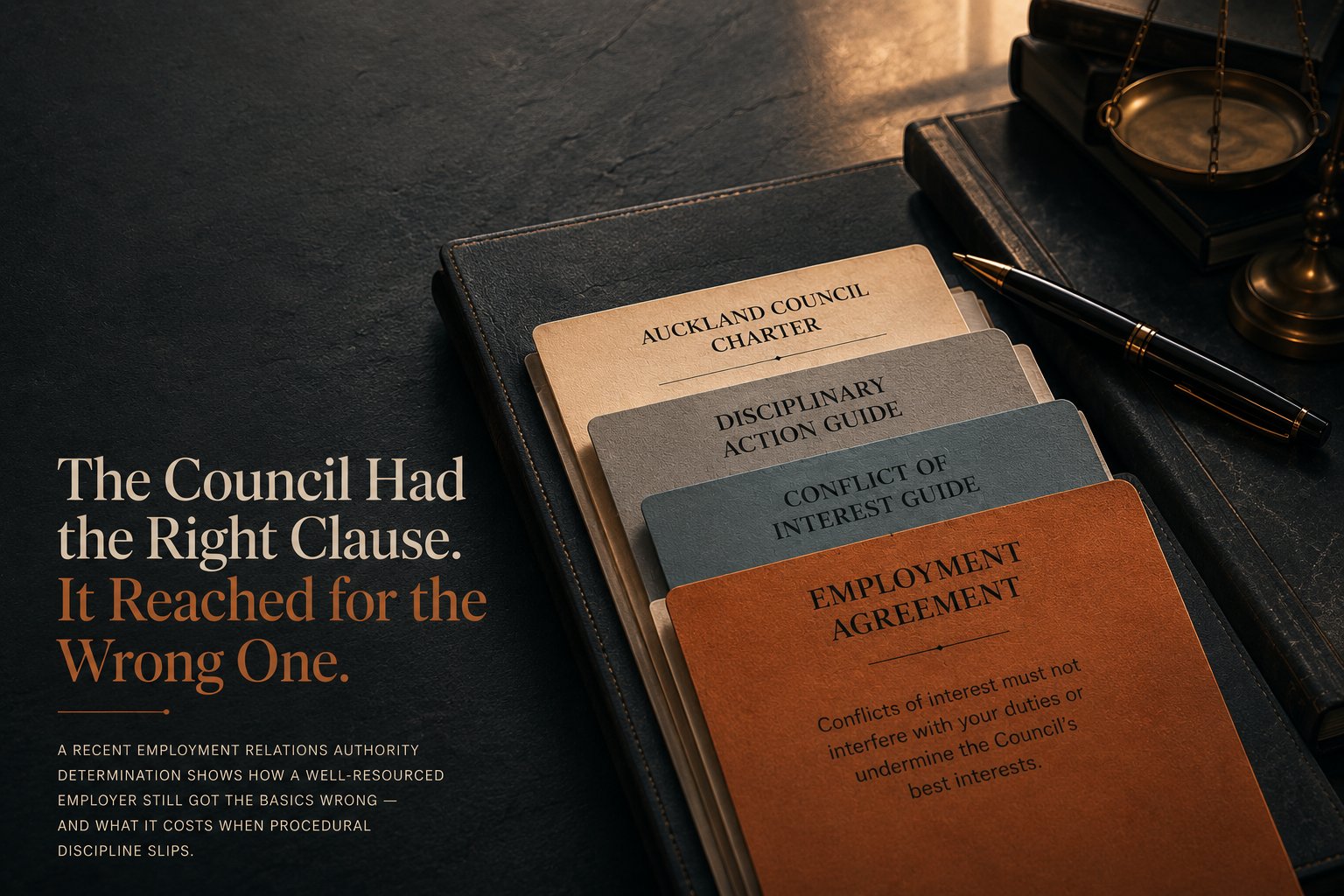
A recent Employment Relations Authority determination shows how a well-resourced employer still got the basics wrong — and what it costs when procedural discipline slips.
Auckland Council knew about Ilalio Solomona's personal training business for close to two years before it did anything about it. A team leader had discovered videos he'd posted to social media at least twelve months before disciplinary action began. His line manager knew, from casual conversation on walks together. The centre manager knew by November 2024 at the latest.
Then, in February 2025, Auckland Council summarily dismissed him for it.
The determination in Solomona v Auckland Council [2026] NZERA 418 has been reported as a story about an employee who kept a side hustle secret. Read the Authority's actual findings, and that framing doesn't survive contact with the facts. Member Matthew Piper found Auckland Council "had knowledge of Mr Solomona's business well before raising it with him as a disciplinary issue." Whatever this case is about, it isn't concealment.
It is, instead, a case about an employer that had a perfectly serviceable contractual clause sitting in its own employment agreement — and reached past it for three other documents that didn't fit, in front of a manager who had never worked with the employee before, backed by in-house legal counsel who didn't correct the mismatch either.
— · —
What Actually Happened
Solomona was a fitness instructor at Auckland Council's Birkenhead Pool and Leisure Centre from May 2022. He had run his own personal training business since 2019, before he was ever employed by the Council. His written terms of employment included a conflict of interest clause preventing him from undertaking other business activities that might create a conflict of interest, interfere with his duties, or undermine the Council's best interests.
In mid-2023 he made short "motivational" videos of gym patrons at Birkenhead and posted them to social media, partly to promote his own business. Nothing in the videos themselves was inappropriate, and the Authority found it likely each participant had consented to being filmed. Auckland Council received no complaints about them.
The problem was not the substance of what Solomona did. It was what the Council did next — or rather, what it failed to do for a long time, and then did badly all at once.
Reaching for the Wrong Document
When Auckland Council finally moved on this in January 2025, the disciplinary letter alleged breaches of three internal documents: the Council's Charter, its Disciplinary Action Guide, and its Conflict of Interest Guide. Piper's determination is unusually direct about the third of these. Read properly, the Conflict of Interest Guide was written to govern municipal decision-making — the risk that an employee's decisions as a public servant might benefit themselves or their associates. It was not designed for, and did not sensibly apply to, an employee running a private personal training business outside work hours. Piper found reliance on it "understandably confusing" for Solomona.
Meanwhile, the one document that actually addressed his situation — the conflict of interest clause in his own employment agreement — was never put to him in the disciplinary process at all. Piper noted the Council "could have referred to Mr Solomona's contractual duties… But it did not. It embarked on a different disciplinary process based on different obligations, which was confusing and unfair."
This is worth sitting with, because it is not a story about a small employer without HR capacity. Auckland Council had in-house legal counsel present at the disciplinary meeting. It had the resources, as Piper pointedly observed, to have put the matter squarely to Solomona using the right instrument. It simply didn't.
The Good Faith Problem
Section 4 of the Employment Relations Act 2000 requires parties to an employment relationship to be active and constructive, responsive and communicative. It doesn't hand down a checklist for every situation, but Piper's reasoning here is a clean illustration of what the duty means in practice: knowledge changes what good faith requires of you.
Because Auckland Council had known about the business for a long time before treating it as a disciplinary matter, good faith required an open conversation first — an opportunity to raise the concern, discuss it, and work toward resolution, with a disciplinary process to follow only if that didn't resolve things. Jumping straight to a formal disciplinary process, after sitting on the knowledge, was not "active and constructive." It was a breach of good faith in its own right, separate from and additional to the unjustified dismissal finding.
There's a lesson in there for any employer who has been quietly aware of an issue and is now deciding whether, and how, to act on it. The longer you know and say nothing, the more good faith requires you to raise it as a conversation before you can fairly escalate it as a disciplinary matter.
Testing the Dismissal Itself
Section 103A of the Employment Relations Act 2000 asks whether the employer's actions, and how it acted, were what a fair and reasonable employer could have done in all the circumstances at the time. Piper found they weren't — for reasons that track directly from the wrong-document problem above. Because the Council relied on policies that didn't in substance apply, Solomona never had a fair opportunity to respond to allegations properly put to him, and his responses couldn't be genuinely considered against the right standard. The dismissal was found unjustified.
An Interesting Wrinkle: What "Knowing and Doing Nothing" Is Worth
Here the case gets more nuanced than a simple win for the employee. Solomona still had his remedies reduced by ten per cent, because Piper found his own conduct — running a business offering the same or similar services to his employer's, and filming customers at the workplace to support that business — was blameworthy, even if it fell short of serious misconduct.
But there's a distinction worth drawing out precisely, because it's easy to overstate. Piper did not find that the Council's long knowledge and inaction meant the conflict of interest clause became unenforceable, or that Solomona had somehow earned a right to keep running the business unchallenged. What he found was narrower and more useful: because Solomona had told his line manager about the business, "carrying on his business after having done so cannot properly be regarded as rising to the level of wrongful behaviour." Disclosure didn't erase the conflict. It meant continuing the business, once disclosed, wasn't serious wrongdoing.
Knowledge and inaction, in other words, do two separate things. They obligate the employer to raise a known issue in good faith rather than ambush the employee with it later. And they weaken — without eliminating — the employer's later claim that the conduct was serious enough to justify the most severe response available. Neither of those is the same as saying the clause stopped applying. An employer who sits on a known conflict doesn't lose the right to eventually raise it. It loses the right to treat sitting on it as if it never happened.
The Takeaway for Employers
Auckland Council's failure here wasn't exotic. It was ordinary — the kind of gap that opens up in any organisation of size, where the people who know things (a team leader, a line manager, a centre manager) aren't the people who decide to act on them, and where, by the time someone does decide to act, nobody goes back to check what the actual employment agreement says.
That's a documentation and process discipline problem, not a legal knowledge problem. Auckland Council's lawyers were in the room. What was missing wasn't legal advice — it was the basic administrative step of connecting what the organisation already knew, and already had written into its own contracts, to the process it eventually ran.
For employers managing any situation involving prior knowledge of an issue — a conflict of interest, a policy breach, a performance concern that's been quietly tolerated — the practical questions worth asking before reaching for a disciplinary process are straightforward: What does the employment agreement actually say about this, in writing? Who in the organisation already knew, and for how long? And has anyone had the plain conversation yet, or are we about to skip straight to the letter?
— · —
Lex Praxis provides employment law intelligence and advisory services to employers and law firms. This article is for informational purposes and does not constitute legal advice. For advice specific to your circumstances, contact us directly.
Primary Sources
Legislation
- Employment Relations Act 2000, ss 4, 103A, 123, 124