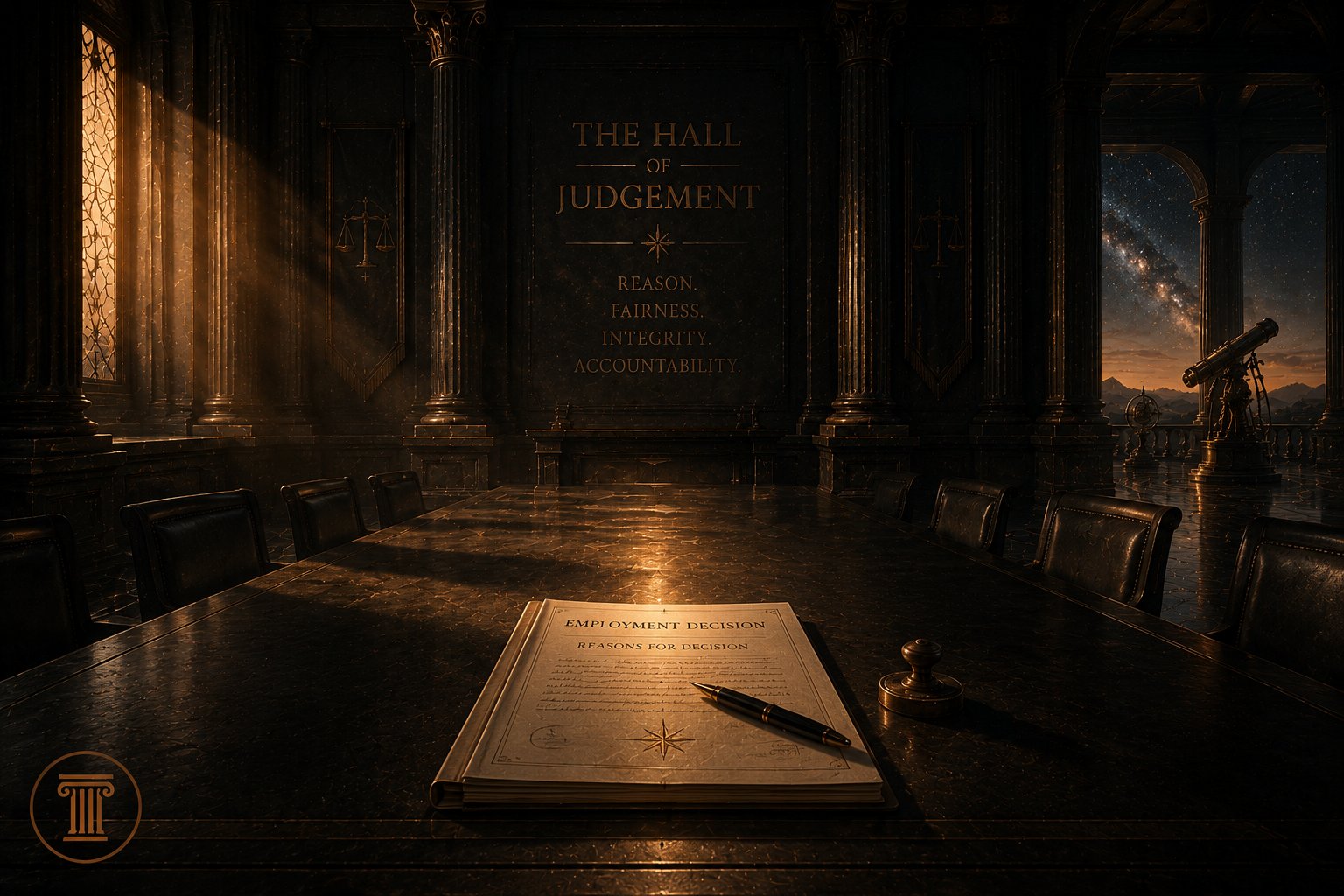
Technology has always promised efficiency.
But when technology helps decide, who stays responsible?
In the workplace, each new generation of tools has offered employers the ability to make faster decisions, gather better information, and manage complexity more effectively. From spreadsheets to software platforms, from automated systems to artificial intelligence, the direction of travel has been consistent: more information, more capability, and more speed.
But every advance in capability drives that question deeper. It presses hardest now, as artificial intelligence moves from curiosity to everyday practice. AI can assist with recruitment, performance analysis, workplace investigations, policy development, and workforce planning. It can find patterns and produce recommendations in seconds.
But employment decisions are not merely calculations.
They involve people.
A redundancy decision affects someone’s livelihood. A performance assessment affects someone’s reputation. A disciplinary process can affect someone’s future. Behind every employment record is a human being whose circumstances, explanations, and dignity must be weighed.
The arrival of AI does not remove that responsibility. It makes it heavier.
The temptation to outsource judgement
The greatest risk of artificial intelligence is not that it makes decisions without humans.
It is that humans begin to accept decisions without thinking.
A recommendation generated by a system can appear objective. Numbers appear neutral. Algorithms appear impartial. But every system reflects choices: what information is used, what assumptions are built into the process, what outcomes are prioritised, and what limitations are left unspoken.
The question is not whether technology can assist a decision.
It can.
The question is whether human judgement is still present when it matters most.
The human judgement principle
A defensible employment decision has always required more than a correct conclusion. It requires a reasonable process, proper consideration of the relevant information, and an ability to explain why the decision was reached.
Artificial intelligence does not change that principle. If anything, it sharpens it.
A decision-maker cannot escape responsibility by saying, “The system recommended it.” The responsibility stays with the human who relies on the recommendation. The same holds whether the information comes from an AI tool, a spreadsheet, a manager’s report, or an investigation file.
Evidence must be weighed.
Assumptions must be tested.
Reasons must be genuine.
Judgement must remain human.
But a principle you cannot show is only a hope.
Judgement that stays human has to leave a trail: a record of what the tool produced, what the decision-maker questioned, what was checked against the source, and why the final call was made. That is the line between an employer who trusted the output and an employer who can stand behind the decision. When a process is tested — by an employee, a grievance, or the Employment Relations Authority — intention counts for little. A decision that can be reconstructed counts for everything.
This is where Lex Praxis works. Not to keep AI out of the workplace, but to make sure the human judgement behind each decision can be traced, explained, and defended.
A decision that can be reconstructed counts for everything.
Principles before technology
The future workplace will not be defined by whether organisations use artificial intelligence — most eventually will. It will be defined by whether they use it responsibly.
That requires principles. Principles that recognise:
- Technology should strengthen human judgement, not replace it.
- Efficiency should not be bought at the cost of fairness.
- Information must be verified before it is relied upon.
- Those who hold workplace power must exercise it with care.
- Every employment decision reaches a human being, not merely a data point.
These principles are not new. They sit at the heart of good employment practice. AI only brings them into sharper focus.

Why this matters
The history of employment law is, in many ways, a history of balancing power.
Employers need room to make decisions; a business cannot operate without difficult choices. But employees are not resources inside a system. They are human beings whose work, security, and dignity turn on those choices.
The strongest organisations will not be the ones with the most advanced technology. They will be the ones that understand where technology ends and responsibility begins.
The question will never be:
“Did the AI make the decision?”
The question will be:
“Who was responsible for making sure the decision was right?”
The future is still human
Artificial intelligence will keep changing the way we work. It will grow faster, more capable, and more woven into ordinary business decisions.
But the central requirement does not change.
Judgement.
Not artificial judgement.
Human judgement.
The organisations that understand this will not treat AI as a replacement for responsibility. They will treat it as a tool that demands more of it.
The workplace of the coming years will not belong to those who hand their judgement to the machine. It will belong to those who use the machine well, and answer for what they decide.
Lex Praxis advises New Zealand employers on employment law and AI governance. This article is general commentary and does not constitute legal advice. For advice specific to your circumstances, contact us directly.