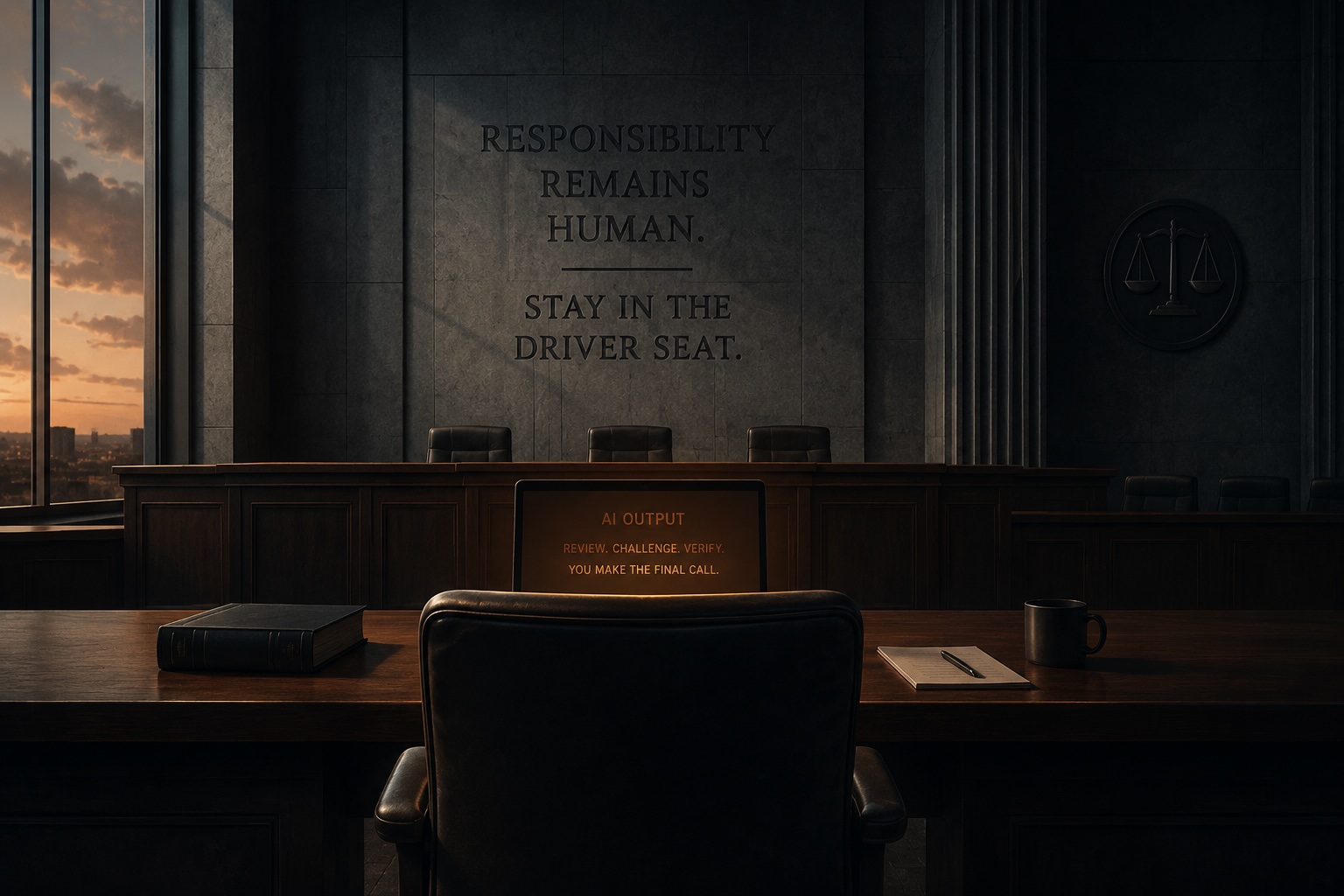
On 14 May 2026, a LinkedIn member posted a sceptical warning about CoCounsel — Thomson Reuters' AI integration built on Anthropic's Claude. He wasn't wrong to be sceptical. The concerns were legitimate. The failures he referenced were real.
My comment was short: "AI is just a tool to be used tactfully. You are still in the driver's seat."
It landed well enough, but I've been thinking about why it did, and I think it's because the comment said something that isn't being said clearly enough in the conversation about AI and legal practice.
The problem is not the tool.
Every AI hallucination that has appeared in a legal filing, every privilege failure, every fabricated citation that made it past review and into a court document — each one carried a human signature. In other words, a lawyer or employment law practitioner signed off on it before being filed.
The failures we keep attributing to AI are, on closer examination, failures of professional judgement or, at this stage, negligence. And that distinction matters — legally, professionally, and for anyone trying to figure out how to use these tools responsibly.
The Incidents We Keep Misreading
The incidents are well documented. Two of them are worth examining carefully.
In Concord Music Group v. Anthropic USA, law firm Latham & Watkins found itself associated with a hallucinated citation. The irony is almost elegant: a case involving Anthropic's own technology produced a filing moment that became a cautionary tale for the entire industry. The citation didn't exist — an incorrect footnote about an expert report with made-up title and authors. A large language model, operating with its characteristic fluency and its characteristic indifference to truth, had generated something that looked real but wasn't.
But here is the question that rarely follows the headline: who filed it? Not the model. A lawyer did. A qualified professional, with professional obligations, put their name to a document that had not been adequately verified. The tool produced the error. The practitioner transmitted it to a court.
Then there is United States v. Heppner, decided in the Southern District of New York in February 2026. The facts involved consumer-grade Claude output that failed to satisfy the privilege test. The professional wrapper — the legal context in which the output was used — was insufficient to protect what the practitioner may have assumed was protected. The lesson is not that AI cannot be used in privileged communications. The lesson is that the legal status of an output is not determined by the tool that produced it. It is determined by the workflow, the professional context, and the judgement of the practitioner who deployed it.
In both cases, the press reached for the same frame: AI fails lawyers. But the more accurate frame is harder to accept. Lawyers failed their clients — and failed their professional obligations — by treating AI output as a finished product rather than a starting point.
The tool did not abandon the driver's seat. The practitioner did.
The Governance Gap Is Real — But It Is Not an Excuse
New Zealand is not immune to this.
The AI Forum NZ's March 2025 report found that 82 percent of New Zealand organisations were using AI with a significant governance gap — deploying the technology without the frameworks, policies, or professional protocols to manage it responsibly. In legal practice, that gap carries particular weight. Professional obligations do not pause while the profession catches up.
The Courts of New Zealand made this clear in their Generative AI Guidelines, issued in December 2023. The guidance is not complex. It is, in fact, rather straightforward: existing professional obligations apply. The use of generative AI tools does not create a new category of excuse. Accuracy obligations remain. Candour obligations remain. The duty not to mislead the court remains. If AI-generated content appears in a filing, the practitioner who signed it owns it.
And the tools are proliferating. Mike — a free, open-source legal AI available at mikeoss.com — is one example of how rapidly the barrier to entry is dropping. Shadow AI, the informal use of AI tools outside any firm policy or governance framework, is already a reality in many workplaces. It is not a future risk. It is a present one. Practitioners are using these tools now, without oversight, without verification protocols, and sometimes without a clear understanding of where the output came from or what assumptions it contains.
The governance gap is real. Acknowledging it is important. But it is not a defence. And it is not a substitute for professional judgement.
What the Driver's Seat Actually Means
The metaphor deserves precision, because it is easy to misread.
Staying in the driver's seat does not mean doing everything manually. It does not mean refusing to use AI. It does not mean treating every output with paranoid suspicion, or reverting to research methods that belong to a different decade. Modern drivers use GPS, adaptive cruise control, lane assist, and a dozen other systems that augment their judgement and reduce their cognitive load. None of that makes the driver less responsible for the journey. It makes them better equipped to complete it safely.
The same logic applies to AI in legal practice.
The practitioner chooses the destination — the legal question, the research scope, the analytical frame. The practitioner reads the road conditions — the jurisdiction, the client's risk profile, the specific facts. The practitioner remains responsible for the journey — every output reviewed, every citation verified, every conclusion tested against primary sources and professional experience. And if something goes wrong, the practitioner is accountable. Not the tool.
This is the distinction that matters to me, and to Lex Praxis as a practice. AI-augmented is not the same as AI-powered. When AI is the instrument and the practitioner is the differentiator, the work improves. When AI becomes the principal and the practitioner becomes the passenger, the risk is not hypothetical — it is, as the cases above demonstrate, a matter of public record.
Verification is not a bureaucratic inconvenience. It is a professional discipline. The approach I use in my own practice — a structured verification framework that moves through source checking, cross-model validation, temporal testing, and confidence signal prompting, among other steps — is not complex. But it requires the practitioner to stay engaged. To remain curious. To treat AI output as a hypothesis to be tested, not a conclusion to be adopted.
That is what the driver's seat looks like in practice.
What New Zealand Firms Need to Do Now
The conversation in New Zealand legal circles has been slower than the technology. That is understandable. It is also becoming untenable.
Three decisions now sit in front of every law firm and every HR function that uses AI in any meaningful way.
Informal AI use is already happening in your organisation. The relevant question is no longer whether to permit it, but whether it is governed. A vacuum is not a policy. It is an unmanaged risk. Lawyers who use AI tools without firm guidance are not protected by the absence of a rule; they are exposed by it.
AI literacy in a legal context is not about knowing which tools exist or how to write a sophisticated prompt. It is about knowing when not to trust the output. It is about recognising the tell-tale signs of a confident hallucination — the fluent, plausible, entirely fabricated case reference. It is about building the professional instinct to question what looks right. That is a skill. It is teachable. Most firms are not yet teaching it.
Who in your firm owns the output of an AI-assisted research task? Who reviews it? Who signs off? If those questions do not have clear answers, the driver's seat is, in practice, empty. And an empty driver's seat is not a governance position. It is unnecessary exposure.
The Measured Voice
Scepticism is professional hygiene in a market flooded with AI enthusiasm and vendor confidence. The legal profession, above most, has reason to be careful. The obligations are real. The cases are real. The risks are not theoretical.
But scepticism is not the same as abstention. And abstention, in a world where AI tools are already embedded in legal research, document review, and client-facing advice, is not a protective strategy. It is a way of ceding ground — to less careful competitors, to less scrupulous practitioners, and to the shadow AI already running quietly in the background of your own organisation.
The problem was never the tool.
The problem is the practitioner who mistakes the tool's fluency for their own judgement. Who treats a well-written AI output as a conclusion rather than a starting point. Who signs their name to something they have not truly read.
Get back in the driver's seat. Stay there. And if you are not sure where the seat is, or what staying in it requires — that is where the real work begins.